FROM GODDESS TO KING
A History of Ancient Europe from the
OERA LINDA BOOK
By Anthony Radford
CHAPTER 21
FRYA, THE FORGOTTEN GODDESS
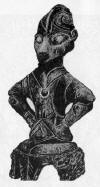 | A 6000 year old statue found in Yugoslavia that is believed to be of the Mother Goddess Frya. |
To the Frisians, Frya was their Great Mother, the mother of the white race. She was teacher and lawgiver, so wise, so beautiful, the perfect creation of the Oldest One, Wr-Alda or God. She gave birth to their ancestors, twenty-four at a time, twelve men and twelve women every year. This was the third experiment in the creation of human life after Lyda, the mother of the black race and Finda, the mother of the yellow race. They claim that on the third try, the Mother was given a conscience which prevented some of the deceit and domination they liked to characterize in the priests and princes of the other two races but in particular, the yellow race. They claim that all the races of mankind are descended from combinations of these three basic root races. There is at least evidence of this so far as Europe is concerned in its racial makeup.
Her laws were given to her children after the great geological disaster that destroyed the old land, Atland, or their ancient home. They were designed to protect a new society, which would no longer have direct access to their mother. They would use an Earth Mother and local maidens to answer their questions of justice, to be the conscience of their many different states that encompassed the entire continent of Europe. Frya was leaving. After giving her sacred Tex to Fasta, her first Earth Mother, she ascended heavenward to her watch-star where she continued to watch over her children. Again, we have a very common aspect of the myths of divinity. The gods do not die, they have celestial homes to where they can retreat.
For the next two thousand years Frya was openly and officially acknowledged as the Great Mother next to Wr-Alda or God and Irtha or Mother Earth herself. Her followers grew less and less numerous, occupying a smaller and smaller Fryasland until the whole system of matriarchal maidens and their virgin helpers tending the sacred lamps first lit by Frya had become no more than a power tool in the hands of ambitious male kings. If it is put in perspective, however, a two-thousand-year-old nation based upon both the principles of individual freedom and community service for male and female citizens is unique.
The peoples of North and Western Europe did not easily forget Frya even after the deliberate suppression of her following by Christian monks. Like all enlightened entities or personages, she never wanted to be worshipped. A follower or disciple is one who has the discipline to follow the teachings, which are for the benefit of those followers themselves not the praise of the goddess. This too, eventually became corrupted into goddess worship and prayer for benefactions, to satisfy desires and alleviate hardships. The teachings in The Oera Linda Book tell us of few direct boons from Frya and her earth mothers. Instead they teach how self-reliance and cooperation with others together yield favorable results for whoever is willing to work. There is no distinction here for her children, as the same laws apply to the children of Lyda and Finda, all children of Wr-Alda.
What do the published records tell us about Frya? Starting with the popular encyclopedias, we find that Frya is not mentioned but that she had many names and many spellings, such as Frigg, Friia, Mardoll, Horn, Gefin and Syr, mostly developed during early Christian times when pagan beliefs were hard to eradicate. Freya is mentioned in the Encyclopaedia Britannica as the sister and female counterpart of Freyr or Frey, a son of the fertility god Njord. She is the most renowned goddess of Norse mythology in charge of love, fertility, battle and death. Pigs were sacred to her and she rode a sow with golden whiskers and drove a chariot drawn by cats.
She chose half of the heroes slain in battle for her great hall of Folkvanger while Odin or Wodin got the rest for Valhalla. One story we recognize while the feminine version is little known. Freya is accused of teaching witchcraft to the Aesir tribe of gods, where she was known as Frigg, the wife of Odin, even the mother of Thor, perhaps part of the campaign to discredit her. Another story has her searching the world for her lost husband, the father of her children Hnoss and Gersemi and weeping tears of gold.
Frigg is remembered in Iceland as the mother of Balder who died despite her efforts to save him. She was depicted as a loving mother and also as a person of loose morals. In Germany there is Frija and Frea the warrior wife of Godan or Wodin. All these stories with their various permutations date from a time two to three thousand years after the actual recorded presence of Frya in Europe, and have projected on them many of the very human frailties and much of the sorcery that the Magi used for political control. Freya is remembered in Sweden and Iceland, but has little presence in her home land of Friesland, although throughout Europe there are many place-names and family names derived from Frya. Perhaps the English words of "free" and "friend" are the best known of these.
Most of us like to hear a good story, and many of these stories were part of an oral tradition that embellished them. Just as today’s soap operas do not represent an average family but dramatize elements of anguish and frailty, so too has mythology emphasized the suffering of the heroes. Such embroidering brings heroes down to a human level as well as up to a god level, but the more mundane or nobler truths surrounding their origins in history are put at risk.
A way to discover Frya is to research Fasta, the chosen first Earth Mother who had the divine connection with Frya. In Greece Hestia was the goddess of the hearth and one of the twelve Olympian deities. She presided over all sacrifices, something that Fasta would not have appreciated, and was also celibate. In Rome, six Vestal Virgins were attached to the temple of the goddess Vesta. They served for thirty years beginning at an age between six and nine and were chosen from patrician families by the pontificus maximus (head priest). They previously served a shorter time but were subject to many rules and traditions that were already ancient in the time of Rome. Besides annual fertility festivals and cleansing rituals for the city, they tended the sacred fire that was symbolic of the need for fire in the hearth of every home. The fire was probably in the form of a lamp, or else embers of charcoal, but the symbolism had survived.
The earlier kings of Rome bore the title: "King of the Sacred Rites" which may be indicative of Finda origins and the fact that a man was in charge and chose the virgins demonstrates this as well. Politics, not religion, was the dominating force, and all this is 2000 years after Fasta, a remarkable if distorted lineage.
Fasta’s laws were a divine prototype from Frya. Man had to grow up and take charge of his own life, a theme reflected in most ancient myths as well as in individual lives, but it was not without help from above. Both Holy Scriptures and new age writings suggest that our transformations and developments are said to be inspired or breathed into us from something greater than ourselves. Frya’s sacred Tex is more of a social and moral code than a contract of civil law but a practical Fasta produced a code complete for the new society of the time. It may well have established our present elements of contracts, welfare and the parliamentary system as well as the concept of legal precedence. Fasta’s code also molded their society for millennia to come, something that cannot be claimed for Hammurabi who lived four hundred years later in Babylon and has been credited with being the first law codifier.
Western civilization traces much of its very earliest culture to Mesopotamia, such as astronomy, geometry and the Biblical stories of Genesis which originate from the very beginning of recorded times, much older than the Hebrew versions with which we are familiar. That influence may even have been of a global nature. If Frya was a goddess or an omniscient, omnipotent being, she would have known of the ancient East, even been a part of it. Proponents of space theories of the gods, will be intrigued by very early statues reputed to be of Frya showing her in flight gear. They are older than the earth mothers, The most famous of these is a seven-inch idol found in Yugoslavia and reputed to be 6000 years old. It portrays an "outfit" which cannot be called ordinary clothing; a helmet with facemask and goggles, pressure bands on the suit and a pendant that looks like an instrument. Then there are numerous statues, both earlier and later, of pregnant women or "Venuses" that have been lumped together as fertility goddesses. These have been found from Russia to Bulgaria to France. According to the Book, the whole of Europe was once Frya’s land before the first disaster of the twenty-second century BC. Could these figurines represent Frya, the literal mother figure of their mythology?
Gods and goddesses have changed their sex throughout the ages. Women priestesses have worn false beards, and male priests and kings have worn false breasts. Could it be possible that the Nordic god Frey was once the goddess Frya? In Swedish mythology he has been called the consort of Freya while other traditions say that Frey or Freyr is just a form of address like lord. Could the Indian god Indira once have been the goddess Finda? The storytellers have never missed an opportunity to embellish or change a tale if it improves its acceptance anymore than the businessmen priests could resist the solidification of a power.
By the time of the early Christian Church in Europe, the pagan religion was no longer the original simple belief system that Frya inspired, but one corrupted by thousands of years of superstition and magical rites. Some of our own surviving festivals such as May Day, Halloween, even Easter and Christmas are adaptations of earlier superstitious yearly events but neither Frya’s land nor the modern age can give the "religious experience" that the Magy could deliver. Early Christianity was impinged on the populous by some idealistic kings that saw a more pure connection in the new religion than those beliefs that were current at the time, however, the zeal of the enforcers suppressed the very knowledge of the origins of the pagan cultures. Neither the old ways nor the new viewpoints were serving a feminine side to be experienced by the psychological need of the people. Western man was being forced into a patriarchal age isolated from his soul.