FROM GODDESS TO KING
A History of Ancient Europe from the
OERA LINDA BOOK
By Anthony Radford
CHAPTER 12
TALES OF HOMER
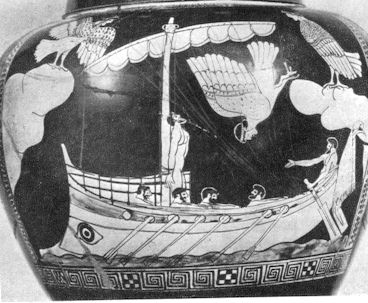
 | Odyseus tied to the mast, defies the lure of the Sirens |
The two best known epic poems of ancient Greece are the Iliad and the Odyssey. It is presumed that they were written or at least recorded by Homer, an eighth century BC blind Ionian poet. There is a difference in the writing styles but that could be because of the long oral tradition that preceded the recording of these tales. Their chief value has been the poetic inspiration to Western literature having being translated and quoted innumerable times. Since Heinrich Schlieman discovered the site of Troy and Arthur Evans excavated Knossos on Crete, legends, which are recorded myths, have been taken more seriously.
The Iliad is regarded as the first example of Hellenic unity. The story concerns the wrath of Achilles who had been slighted by Agamemnon, the commander in chief of the Greek army that invaded Troy in Asia Minor. Ulysses is the King of the contingent from Ithaca during the ten year Trojan War.
The Odyssey is the story of the difficulties that Ulysses encounters on his return voyage to his home in Ithaca, a series of adventures that took an additional ten years. The beginning of the return voyage has been traced on maps and duplicated by several modern sailing craft through islands of north Africa, possibly Malta and back to Ithaca or actually a neighboring island, more likely to have been his ancient home. There is still the unknown nine years of the tale in which Ulysses is supposed to have been on the island of Ogygia and under the enchantment of the priestess Calypso. According to Homer he escaped from her charms but was shipwrecked being the sole, naked survivor. Ogygia was known as a name for Egypt in Byzantium times but in more ancient times could have been the name for Pharos Island. This island near Alexandria was a large and important port of the "Peoples of the Sea" according to ancient Egyptian recordings but that tiny, largely man-made island hardly fits the story of Homer.
In our ancient account Odysseus, or Ulysses as they knew him, is mentioned but a different view of this famous hero of old is given. Some light is shed on that missing nine years and even the Trojan War can be dated. Elsewhere, the Book makes mention of survivors from Troy (Etruscans) settling in Italy and founding the city of Rome, that fact being a known but not proven tradition.
Trade between the Rhine and the Mediterranean must have been an annual event with Frisian and Phoenician ships accounting for most of the traffic. Here we read how Greek ships, which probably included Italian, Cretan and Ionian vessels as well, had not arrived in the port where "all men" could trade for twelve years. Could this have been because of the Trojan War? We also notice some spelling changes in the proper names. Old Frisian was becoming Germanized.
Again we have a reference to Italians where they plainly meant Greeks. The year is 1188 BC (1005 - 2193 = -1188) and we are introduced to their version of the story of Ulysses. This odyssey shows the adventurer trying to get a sacred lamp from the Earth Mother in order to fulfill a prophecy that he would become king of Greece. Failing that he moved to the Frisian Island of Walhallagara (modern Walcheren) and was indeed enchanted by Kalip, the maiden there, even if her lip did jut out like a ship’s prow. After years he gets a lamp but loses it in a shipwreck, being the sole naked survivor. The real life story is not as glamorous as Homer’s tale but a good story always improves in the telling.
In the Year One Thousand and Five After Atland was Submerged this was Inscribed on the Eastern Wall of Fryasburgt:
After twelve years had elapsed without our seeing any Italians in Almanland, there came three ships, finer than any that we possessed or had ever seen.
On the largest of them was a king of the Jonischen Islands, whose name was Ulysses, the fame of whose wisdom was great. To him a priestess had prophesied that he should become the king of all Italy provided he could obtain a lamp that had been lighted at the lamp in Texland. For this purpose he had brought great treasures with him, above all jewels for women more beautiful than had ever been seen before. They were from Troy, a town that the Greeks had taken. All these treasures he offered to the mother, but the mother would have nothing to do with him.
At last, when he found that there was nothing to be obtained from her, he went to Walhallagara. There was established a burgtmaid whose name was Kaat, but who was commonly called Kalip, because her lower lip stuck out like a masthead. Here he tarried for years, to the scandal of all that knew it. According to the report of the maidens, he obtained a lamp from her; but it did him no good, because when he got to sea his ship was lost, and he was taken up naked and destitute by another ship.
Ulysses had a shipmate who related the following account of what happened to Athens after the Geertmen left. The Egyptian Cecrops continued to rule with high respect for Frisian customs but that attitude did not outlast him.
This tale is typical of the theme of the Oera Linda Book; the loss of Frya’s ways and their replacement with what they termed was Finda’s selfish extravagance. We have had Puritanism and in our own time, even Communism, both trying to limit extravagance and promote the sharing of resources for the common good but unfortunately we witness them succumbing to the natural greed or selfish survival instincts of human nature. It was no different then. It is simply a persistent fact that inhabitants of colder climates have had to cooperate to survive while those of more temperate climes have had the leisure to be able to express themselves in colorful arts and activities that were regarded as sinful by the northerners such as clothes that could become a decoration, not just a necessity for keeping warm.
There was left behind this king (Ulysses) a writer of pure Frya’s blood, born in the new harbor of Athens, who wrote for us what follows about Athens, from which may be seen how truly the Mother Hellicht spoke when she said that the customs of Frya could never take firm hold in Athens.
From the other Greeks you will have heard a great deal of bad about Cecrops, because he was not in good repute; but I dare affirm that he was an enlightened man, very renowned both among the inhabitants and among us, for he was against oppression, unlike the other priests, and was virtuous, and knew how to value the wisdom of distant nations. Knowing that, he permitted us to live according to our own Asegaboek. There was story current that he was favorable to us because he was the son of a Frisian girl and an Egyptian priest: the reason of this was that he had blue eyes, and that many of our girls had been stolen and sold to Egypt, but he never confirmed this. However it may have been, certain it is that he showed us more friendship than all the other priests together.
When he died, his successors soon began to tear up our charters, and gradually to enact so many unsuitable statues that at long last nothing remained of liberty but the shadow and the name. Besides, they would not allow the laws to be written so that the knowledge of them was hidden from us. Formerly all the cases in Athens were pleaded in our language, but afterwards in both languages, and at last in the native tongue only. At first the men of Athens only married women of our own race, but the young men as they grew up with the girls of the country took them to wife. The bastard children of this connection were the most handsome and cleverest in the world; but they were likewise the wickedest, wavering between the two parties, paying no regard to laws or customs except where they suited their own interests.
As long as a ray of Frya’s spirit existed, all the building materials were for common use, and no one might build a house larger or better than his neighbors; but when some degenerate townspeople got rich by sea-voyages and by the silver that their slaves got in the silver countries, they went to live out on the hills or in the valleys. There, behind high enclosures of trees or walls, they built palaces with costly furniture, and in order to remain in good order with the nasty priests, they placed there likenesses of false gods and unchaste statues.
Sometimes the dirty priests and princes wished for the boys rather than the girls, and often led them astray from the paths of virtue by rich presents or by force. Because riches were more valued by this lost and degenerate race than virtue or honor, one sometimes saw boys dressed in splendid flowing robes, to the disgrace of their parents and maidens, and to the shame of their own sex. If our simple parents came to a general assembly at Athens and made complaints, a cry was raised, Hear, hear! there is a sea-monster going to speak. Such is Athens become, like a morass in a tropical country full of leeches, toads, and poisonous snakes, in which no man of decent habits can set his foot.