TAMERLANE
LIVED FROM 1333-1405
I
TAMERLANE was the son of the chief of a Mongolian tribe in Central Asia. His real name was Timour, but as he was lamed in battle when a youth he was generally called Timour the Lame, and this name was gradually changed to Tamerlane. He was born in 1333, so that he lived in the time of the English king, Edward III, when the Black Prince was winning his victories over the French. He was a descendant of a celebrated Tatar soldier, Genghis Khan, who conquered Persia, China, and other countries of Asia. When twenty-four years old Tamerlane became the head of his tribe, and in a few years he made himself the leader of the whole Mongolian race.
He was a tall, stern-looking man, of great strength, and, although lame in his right leg, could ride a spirited horse at full gallop and do all the work of an active soldier. He was as brave as a lion--and as cruel.
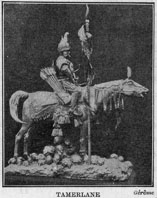
He chose the ancient city of Samarcand, in Turkistan, for his capital; and here he built a beautiful marble palace, where he lived in the greatest luxury.
After he had enjoyed for some time the honors which fell to him as chief ruler of the Mongolians, he began to desire further conquests. He determined to make himself master of all the countries of Central Asia.
"As there is but one God in heaven," he said, "there ought to be but one ruler on the earth."
So he gathered an immense army from all parts of his dominion, and for weeks his subjects were busy making preparations for war. At length he started for Persia in command of a splendid army. After gaining some brilliant victories he forced the Persian king to flee from his capital.
All the rich country belonging to Persia, from the Tigris to the Euphrates, submitted to the Mongolian conqueror.
Tamerlane celebrated his Persian conquest by magnificent festivities which continued for a week. Then orders were given to march into the great Tatar empire of the North. Here Tamerlane was victorious over the principal chiefs and made them his vassals. In pursuing the Tatars he entered Russia and sacked and burned some of the Russian cities. He did not, however, continue his invasion of this country, but turned in the direction of India.
At last his army stood before the city of Delhi, and after a fierce assault forced it to surrender. Other cities of India were taken and the authority of Tamerlane was established over a large extent of the country.
II
BAJAZET, sultan of Turkey, now determined to stop Tamerlane's eastward march.
News of this reached the conqueror's ears. Leaving India, he marched to meet the sultan. Bajazet was a famous warrior. He was so rapid in his movements in war that he was called "the lightning."
Tamerlane entered the sultan's dominions and devastated them. He stormed Bagdad, and after capturing the place killed thousands of the inhabitants.
At length the rivals and their armies faced each other. A great battle followed. It raged four or five hours and then the Turks were totally defeated. Bajazet was captured.
Tamerlane then ordered a great iron cage to be made and forced the sultan to enter it. The prisoner was chained to the iron bars of the cage and was thus exhibited to the Mongol soldiers, who taunted him as he was carried along the lines.
As the army marched from place to place the sultan in his cage was shown to the people. How long the fallen monarch had to bear this humiliating punishment is not known.
Tamerlane's dominions now embraced a large part of Asia. He retired to his palace at Samarcand and for several weeks indulged in festivities.
He could not, however, long be content away from the field of battle. So he made up his mind to invade the Empire of China. At the head of a great army of two hundred thousand soldiers he marched from the city of Samarcand towards China. He had gone about three hundred miles on the way when, in February, 1405, he was taken sick and died. His army was disbanded and all thought of invading China was given up.
Thus passed away one of the greatest conquerors of the Middle Ages. He was a soldier of genius but he cannot be called a truly great man. His vast empire speedily fell to pieces after his death. Since his day there has been no leader like him in that part of Asia.
Next: Henry V. King From 1413-1422