EGBERT
KING FROM 802-837
I
EGBERT the Saxon lived at the same time as did Harun-al-Rashid and Charlemagne. He was the first king who ruled all England as one kingdom. Long before his birth the people who are known to us as Britons lived there, and they gave to the island the name Britain.
But Britain was invaded by the Romans under Julius Cesar and his successors, and all that part of it which we now call England was added to the Empire of Rome. The Britons were driven into Wales and Cornwall, the western sections of the island.
The Romans kept possession of the island for nearly four hundred years. They did not leave it until 410, the year that Alaric sacked the city of Rome. At this time the Roman legions were withdrawn from Britain.
Some years before this the Saxons, Angles and Jutes, German tribes, had settled near the shores of the North Sea. They learned much about Britain; for trading vessels, even at that early day, crossed the Channel. Among other things, the men from the north learned that Britain was crossed with good Roman roads, and dotted with houses of brick and stone; that walled cities had taken the place of tented camps, and that the country for miles round each city was green every spring with waving wheat, or white with orchard blossoms.
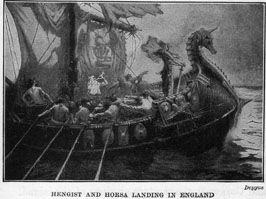
After the Roman legions had left Britain, the Jutes, led, it is said, by two great captains named Hengist and Horsa, landed upon the southeastern coast and made a settlement.
Britain proved a pleasant place to live in, and soon the Angles and Saxons also left the North Sea shores and invaded the beautiful island.
The new invaders met with brave resistance. The Britons were headed by King Arthur, about whom many marvelous stories are told. His court was held at Caerleon, in North Wales, where his hundred and fifty knights banqueted at their famous "Round Table."
The British king and his knights fought with desperate heroism. But they could not drive back the Saxons and their companions and were obliged to seek refuge in the western mountainous parts of the island, just as their forefathers had done when the Romans invaded Britain. Thus nearly all England came into the possession of the three invading tribes.
II
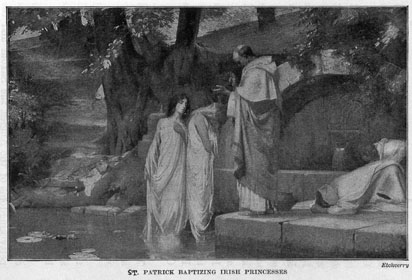
ARTHUR and his knights were devoted Christians. For the Romans had not only made good roads and built strong walls and forts in Britain, but they had also brought the Christian religion into the island. And at about the time of the Saxon invasion St. Patrick was founding churches and monasteries in Ireland, and was baptizing whole clans of the Irish at a time. It is said that he baptized 12,000 persons with his own hand. Missionaries were sent out by the Irish Church to convert the wild Picts of Scotland and at a later day the distant barbarians of Germany and Switzerland.
The Saxons, Angles, and Jutes believed in the old Norse gods, and Tiew and Woden, Thor and Friga, or Frija, were worshiped on the soil of Britain for more than a hundred years.
The Britons tried to convert their conquerors, but the invaders did not care to be taught religion by those whom they had conquered; so the British missionaries found the work unusually hard. Aid came to them in a singular way. At some time near the year 575 A.D., the Saxons quarreled and fought with their friends, the Angles. They took some Angles prisoners and carried them to Rome to be sold in the great slave-market there. A monk named Gregory passed one day through the market and saw these captives. He asked the dealer who they were. "Angles," was the answer.
"Oh," said the monk, "they would be angels instead of Angles if they were only Christians; for they certainly have the faces of angels."
Years after, when that monk was the Pope of Rome, he remembered this conversation and sent the monk Augustine to England to teach the Christian religion to the savage but angel-faced Angles. Augustine and the British missionaries converted the Anglo-Saxons two hundred years before the German Saxons were converted.
Still, though both Angles and Saxons called themselves Christians, they were seldom at peace; and for more than two hundred years they frequently fought. Various chiefs tried to make themselves kings; and at length there came to be no less than seven small kingdoms in South Britain.
In 784 Egbert claimed to be heir of the kingdom called Wessex; but the people elected another man and Egbert had to flee for his life. He went to the court of Charlemagne, and was with the great king of the Franks in Rome on Christmas Day, 800, when the Pope placed the crown on Charles' head and proclaimed him emperor.
Soon after this a welcome message came to Egbert. The mind of the people in Wessex had changed and they had elected him king. So bidding farewell to Charlemagne, he hurried to England.
Egbert had seen how Charlemagne had compelled the different quarreling tribes of Germany to yield allegiance to him and how after uniting his empire he had ruled it well.
Egbert did in England what Charlemagne had done in Germany. He either persuaded the various petty kingdoms of the Angles, the Saxons and the Jutes to recognize him as their ruler, or forced them to do so; and thus under him all England became one united kingdom.
But Egbert did even better than this. He did much to harmonize the different tribes by his wise conciliation. The name "England" is a memorial of this; for though Egbert himself was a Saxon, he advised that to please the Angles the country should be called Anglia, that is, Angleland or England, the land of the Angles, instead of Saxonia, or Saxonland.
Next: Rollo The Viking. Died 931 A.D.