CANUTE THE GREAT
KING FROM 1014-1035
I
THE Danes, you remember, had the eastern and northern parts of England in the time of Alfred. Alfred's successors drove them farther and farther north, and at length the Danish kingdom in England came to an end for a time.
But the Danes in Denmark did not forget that there had been such a kingdom and in the year 1013 Sweyn, King of Denmark, invaded England and defeated the Anglo-Saxons. Ethelred, their king, fled to Normandy.
Sweyn now called himself the king of England; but in a short time he died and his son Canute succeeded to his throne. Canute was nineteen years old. He had been his father's companion during the war with the Anglo-Saxons, and thus had had a good deal of experience as a soldier.
After the death of Sweyn some of the Anglo-Saxons recalled King Ethelred and revolted against the Danes.
Canute, however, went to Denmark and there raised one of the largest armies of Danes that had ever been assembled. With this powerful force he sailed to England. When he landed Northumberland and Wessex acknowledged him as king. Shortly after this Ethelred died.
Canute now thought he would find it easy to get possession of all England. This was a mistake.
Ethelred left a son named Edmund Ironside who was a very brave soldier. He became, by his father's death, the king of Saxon England and at once raised an army to defend his kingdom. A battle was fought and Edmund was victorious. This was the first of five battles that were fought in one year. In none of them could the Danes do more than gain a slight advantage now and then.
However, the Saxons were at last defeated in a sixth battle through the act of a traitor. Edric, a Saxon noble, took his men out of the fight and his treachery so weakened the Saxon army that Edmund Ironside had to surrender to Canute.

But the young Dane had greatly admired Edmund for the way in which he had fought against heavy odds, so he now treated him most generously. Canute took certain portions of England and the remainder was given to Edmund Ironside.
Thus for a short time the Anglo-Saxon people had at once a Danish and a Saxon monarch.
II
EDMUND died in 1016 and after his death Canute became sole ruler.
He ruled wisely. He determined to make his Anglo-Saxon subjects forget that he was a foreign conqueror. To show his confidence in them he sent back to Denmark the army he had brought over the sea, keeping on a part of his fleet and a small body of soldiers to act as guards at his palace.
He now depended on the support of his Anglo-Saxon subjects and he won their love.
Although a king--and it is generally believed that kings like flattery--Canute is said to have rebuked his courtiers when they flattered him. On one occasion, when they were talking about his achievements, one of them said to him:
"Most noble king, I believe you can do anything."
Canute sternly rebuked the courtier for these words and then said:
"Come with me, gentlemen."
He led them from the palace grounds to the sea-shore where the tide was rising, and had his chair placed at the edge of the water.
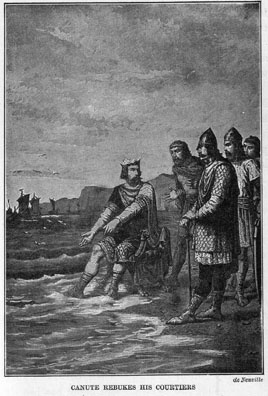
"You say I can do anything," he said to the courtiers. "Very well, I who am king and the lord of the ocean now command these rising waters to go back and not dare wet my feet."
But the tide was disobedient and steadily rose and rose, until the feet of the king were in the water. Turning to his courtiers, Canute said:
"Learn how feeble is the power of earthly kings. None is worthy the name of king but He whom heaven and earth and sea obey."
During Canute's reign England had peace and prosperity and the English people have ever held his memory dear.
Next: The Cid